
The Truth About At-Home Perimenopause Tests: What They Can (and Can’t) Tell You
When I started noticing changes in my energy, mood, sleep and cycle I wondered “Is this perimenopause?” At the time I felt all alone because had always assumed menopasue was still years away.
Like many other women, my first call wasn't to my doctor and not even a friend initially. I logged onto Google to try to determine what was going on. Following numerous searches, I eventually found myself drowning in the abyss of at-home perimenopause tests unable to make sense of which was the right option for me. The Project Manager in me quickly sprang into action and I had to map out a game plan to get the answer I was seeking.
There are numerous choices, which can quickly become overwhelming but allow me to save you some time and share what I've learned. There is no single choice that will work best for everyone, but you can use the info below to help you make a decision on what may be best for you.
Why Test at Home?
In addition to feeling like I was too young to be starting perimenopause, when I finally did start asking my doctor about various symptoms I felt dismissed rather than heard.
Although, I truly wasn't feeling like myself I was being told nothing out of the oridinary was wrong with me, so I was left struggling with what I assumed was just my new normal. However the nagging desire for answers never went away so an at-home test felt like my only hope for some type of answer.
However, I quickly learned not all tests are created equal, and understanding the differences can save you a lot of frustration (as well as a small fortune).
The Four Main Types of At-Home Perimenopause Test
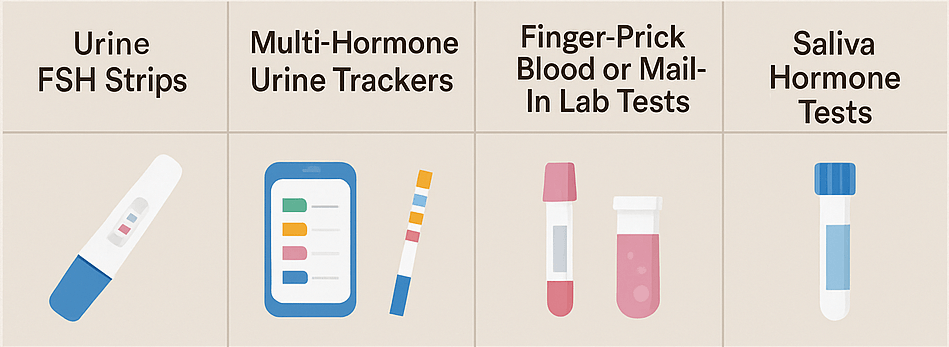
Below is a high level overview of each type including some pros and cons of each as well as a few examples.
1. Urine FSH Strips (Quick Indicators)
What they measure:
Follicle-Stimulating Hormone (FSH), which tends to rise as your ovaries slow down.
How they work:
Similar to a pregnancy test, you dip a strip in urine and read a color change or line pattern indicating whether your FSH is elevated.
Pros:
Quick and inexpensive
Simple to use
Helpful for identifying consistently elevated FSH levels
Cons:
FSH levels fluctuate wildly during perimenopause
Doesn’t measure estrogen, progesterone or trends
May give false reassurance or false panic
These are best for a quick check if you're curious or want to compare results across several months. Examples include: Clearblue® Menopause Stage Indicator and Proov Reserv FSH at Home Test
2. Multi-Hormone Urine Trackers (Pattern Spotters)
What they measure:
Multiple hormones such as FSH, LH (luteinizing hormone), estrogen metabolites (E1G, E3G), and progesterone metabolites (PdG).
How they work:
You collect samples over several days, the app interprets trends to show how your hormone levels rise or fall throughout the cycle.
Pros:
Gives a more complete hormone story
Shows patterns and fluctuations
Non-invasive and easy to repeat
Cons:
Requires consistent testing across multiple days
App algorithms vary and may oversimplify results
Hormone metabolites in urine don’t always match blood levels
These are best for women who love data and want to see trends over time rather than one static snapshot. Examples include: Proov Empower Perimenopause Kit and Mira Fertility & Hormone Tracker
3. Finger-Prick Blood Tests (Lab-Grade Insights)
What they measure:
Typically FSH, estradiol (estrogen), and progesterone; sometimes thyroid or cortisol too.
How they work:
You prick your finger, collect a few blood drops on a card and mail them to a lab for analysis.
Pros:
Quantitative, lab-validated results
Includes reference ranges and downloadable reports
Often includes clinician review or secure dashboard access
Cons:
Expensive and more invasive
Hormone levels change daily so this is still a snapshot
Results may take a week or longer
These are best for women who want medically relevant, shareable data or are working with a functional medicine provider. Examples include: Everlywell Women’s Health Test and EqualDx 6-in-1 at-Home Collection kit
4. Saliva Hormone Tests (Convenience Focused)
What they measure:
Unbound hormones like estrogen, progesterone and sometimes cortisol.
How they work:
You spit into a tube, mail it to a lab and your results arrive online.
Pros:
Easiest to collect
Measures multiple hormones at once
Cons:
Saliva hormone levels can be unreliable for menopause transitions
Results vary based on hydration, time of day, or saliva flow
Not typically used for clinical decision-making
These are best for women who are curious testers and prioritize convenience over precision. Examples include: Verisana Easy at Home Saliva Hormone Test and ZRT® Hormone Testing
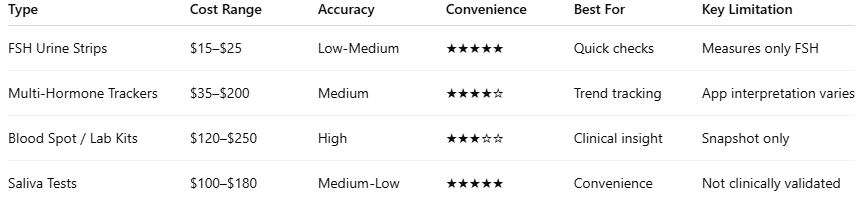
At-Home Perimenopause Test Quick Comparison
What These Tests Can and Can't Tell You
What These Tests Can Tell You:
Easiest to collect
Measures multiple hormones at once
Whether your FSH is consistently high (a marker that your ovaries are slowing down).
Whether estrogen and progesterone levels are declining or erratic.
Patterns that align with symptoms (e.g., energy dips, mood swings, sleep disruption).
Data points you can bring to your healthcare provider for discussion.
What These Tests Cannot Tell You:
Why your hormones are changing since perimenopause, thyroid, stress, or medication can all affect results.
The “right” treatment path since test kits aren’t prescriptive.
How your specific symptoms tie to a single hormone.
Whether you’re “officially” in menopause since that’s defined as 12 months without a period.
How to Choose the Right Kit for You
First determine your goal and how you want to use the data. Are you just curious or do you want clinical data or are you just looking to track your patterns?
Next, are you willing to test multiple times or would you prefer a one and done option? Also consider if this is just for your own personal knowledge or do you intend to share the results with your doctor?
Answering these questions will lead you to which option might be right for you. Use the comparison chart above to quickly determine which would be the best option for you based on your responses.
Also remember these tests should each be FSA/HSA eligible.
In Conclusion
Ultimately, at-home perimenopause test kits can can be incredibly empowering and help women over 40 better understand hormone changes. However, the results should be viewed as clues and necessarily clear-cut conclusions. These tests typically measure FSH, estrogen, progesterone, or related markers using urine, blood, or saliva samples. Quick FSH strips offer convenience but limited accuracy, multi-hormone trackers reveal trends over time, blood-based lab kits provide the most precise data, and saliva tests, while easy, are less reliable for menopause transitions.
The best approach depends on your goals. If you want a quick check, trend tracking, or lab-grade insight. Use test results alongside your symptoms, sleep, and energy patterns to guide next steps with your healthcare provider. When used wisely, these kits can help you navigate midlife with confidence, clarity, and calm.
At the end of the day the most important reason to use at-home perimenopause tests is to use them to advocate for yourself because when you understand your data, you can have much better conversations with your doctor and do so with confidence.
Remember, your hormones are just one part of your midlife map. The true picture emerges when you combine data with how you feel. (your energy, mood, sleep, and focus patterns).
You are the expert of your own experience. These kits can validate what your body has been whispering (or shouting), but they shouldn’t override your own intuition.
YOU MIGHT ALSO LIKE

Who We Are
My Midlife GPS is a guide to help corporate women over 40 confidently navigate midlife changes with real strategies, lessons, and encouragement.
Get Inspiration in your Inbox & Get My FREE Survival Kit!
Free Signup
© 2025. All Rights Reserved